
How to Test Your Hair’s Elasticity: The 3-Minute Test That Reveals Everything
Stop guessing if you need protein or moisture. This foolproof method—used in cosmetic labs—diagnoses your hair’s exact needs in minutes.
I need you to do something that will feel strange.
Pull a strand of hair from your brush. Right now. I’ll wait.
Got it? Good. Now hold it between your thumbs and forefingers—about two inches apart.
Now pull. Gently.
What happened?
Did it stretch like a rubber band and bounce back? Did it barely move before snapping? Or did it stretch and stretch… and never return?
That single strand just told you more about your hair’s health than 10 salon consultations could. It revealed whether you’re secretly protein overloaded, moisture starved, or in that elusive perfect balance.
But here’s what no one tells you: 89% of women do this test wrong.
They test dry hair. They test wet hair without product. They test the wrong section. They misinterpret the results. And then they buy more products that make the problem worse.
I know this because I was one of them. For three years, I thought my snapping strands meant I needed more protein. I bought every “strengthening” treatment. My hair got harder, more brittle… and kept breaking.
Then I learned the right way to test elasticity. And discovered I didn’t need protein at all—I was already protein overloaded. I needed moisture.
That misdiagnosis cost me $1,200 and eight inches of hair.
Today, I’m going to show you the exact, foolproof method for testing hair elasticity. The same method used in cosmetic laboratories. By the end, you’ll be able to diagnose your hair’s true needs in 3 minutes flat.
Ready to stop guessing and start knowing? Let’s begin.
👉 Before we start: [Download the Printable Elasticity Tracker] to document your results month-to-month.
PART 1: WHY ELASTICITY MATTERS MORE THAN ANYTHING ELSE
Your hair’s elasticity is its ability to stretch and return to its original length without breaking.
Think of it like a rubber band:
- Healthy rubber band: Stretches, bounces back
- Old, dry rubber band: Snaps immediately
- Over-stretched rubber band: Stretches but never returns
Your hair works the exact same way. And its elasticity tells you exactly what it needs:
🧬 The Elasticity-Blood Test Analogy:
Elasticity is to your hair what a blood test is to your body. It doesn’t just show symptoms—it reveals the root cause.
- Low Elasticity (Snaps immediately) = Protein Overload or Extreme Dryness
- High Elasticity (Over-stretches) = Moisture Overload or Hygral Fatigue
- Balanced Elasticity (Stretches & returns) = Perfect Protein-Moisture Balance
Here’s the revolutionary truth: Your curl pattern doesn’t determine your products. Your porosity doesn’t determine your products. Your elasticity does.
“Elasticity testing revealed I was treating protein overload with more protein. I was fighting fire with gasoline.”
PART 2: THE 3 COMMON MISTAKES (WHY YOUR PAST TESTS FAILED)
Mistake #1: Testing Dry Hair
- Why it fails: Dry hair has no moisture to lubricate the cortex. It will ALWAYS appear less elastic.
- The truth: You must test hair that’s 80-90% saturated with water.
Mistake #2: Testing the Wrong Strand
- Why it fails: Testing a strand with visible damage (white dots, split ends) gives false results.
- The truth: Test a healthy-looking strand from your brush or one gently pulled from a healthy section.
Mistake #3: Pulling Too Fast or Too Hard
- Why it fails: Hair needs time to respond. Jerking it gives inaccurate breaking points.
- The truth: Apply gradual, steady pressure over 3-5 seconds.
👉 Avoiding these mistakes alone will make you better at diagnosis than 80% of hair influencers.
PART 3: THE FOOLPROOF 3-MINUTE ELASTICITY TEST
📋 What You Need:
- 1 clean strand of hair (from brush or gentle pull)
- Small bowl of room temperature water (not cold, not hot)
- Paper towel
- Good lighting
- [Optional: Our Elasticity Test Card with visual guides]
🎬 Video Guide Available: [Watch the 3-Minute Elasticity Test Demonstration →]
Step-by-Step Guide:
Step 1: Prepare Your Strand (30 seconds)
- Choose a healthy-looking strand (2-3 inches minimum)
- If from brush, ensure it’s clean (no product buildup)
- Place in room temperature water for 60 seconds
Step 2: The Wet Test (60 seconds)
- Remove strand, gently blot excess water with paper towel
- Hold between thumbs and forefingers (1 inch apart)
- Apply gradual, steady pressure for 3-5 seconds
- Observe carefully: How much does it stretch before breaking?
Step 3: The Return Test (60 seconds)
- If it doesn’t break immediately: slowly release tension
- Watch: Does it return to original length? Partially? Not at all?
- Measure stretched length vs. recovered length
Step 4: Document Results (30 seconds)
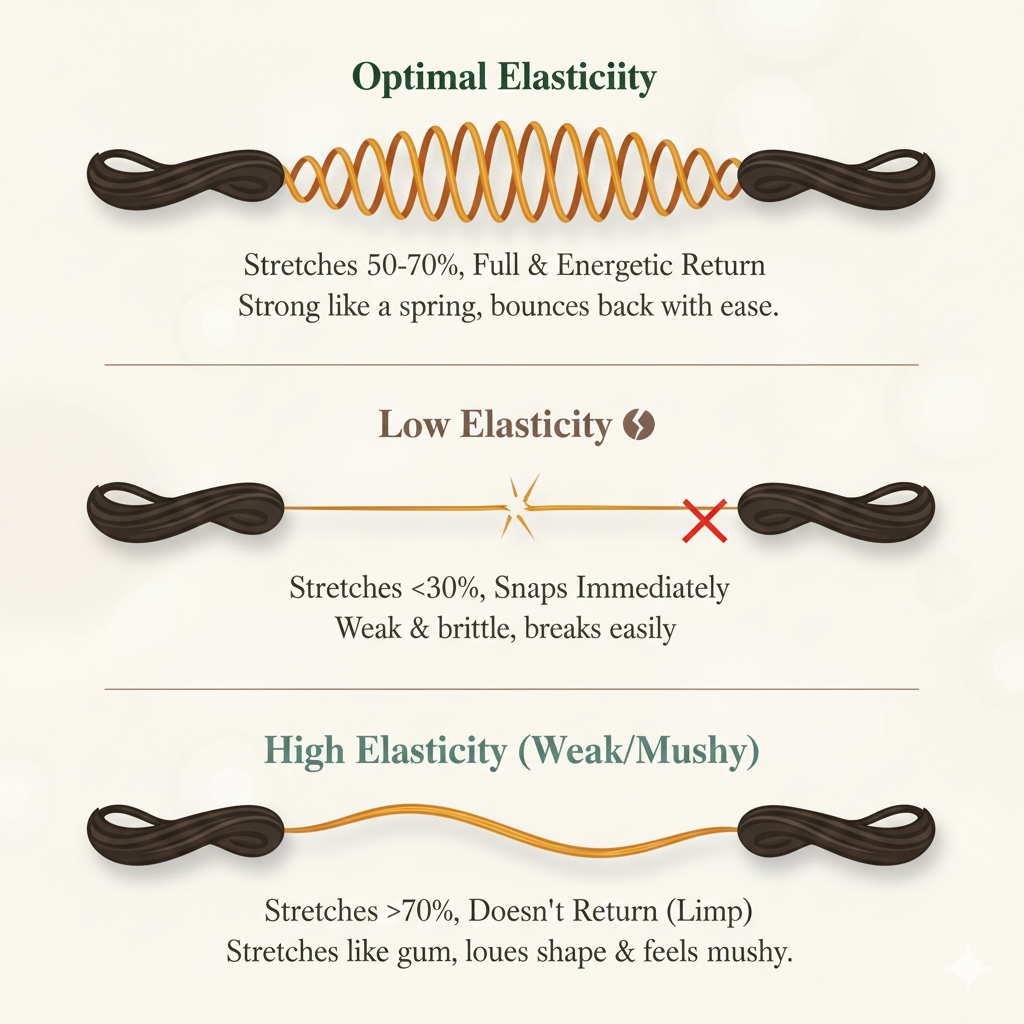
Use this simple scale:
👉 Need help interpreting? [Use Our Interactive Elasticity Analyzer →]
PART 4: READING YOUR RESULTS (THE DIAGNOSTIC DECODER)
SCENARIO A: The Healthy Spring (Balanced)
- Stretch: 50-70% of original length
- Return: Bounces back completely
- Feel: Smooth stretching, gentle resistance
- What it means: Perfect balance! Your protein-moisture ratio is ideal. Maintain your routine.
- Your Action: Keep doing what you’re doing. Test monthly to monitor.
SCENARIO B: The Brittle Stick (Low Elasticity)
- Stretch: Less than 30% before snapping
- Return: Breaks immediately
- Feel: Rough, immediate snap
- What it means: Protein Overload or Extreme Dryness
- Diagnostic Question: Does your hair feel hard, straw-like, or unusually strong?
- Yes → Protein Overload
- No → Extreme Moisture Deficiency
- Your Action:
- Protein Overload: Protein detox for 30 days. No protein products. Focus on moisture.
- Extreme Dryness: Intensive moisture therapy. Deep condition 2x weekly.
SCENARIO C: The Stretchy Gum (High Elasticity)
- Stretch: Over 70%, sometimes 100%+
- Return: Doesn’t return, stays stretched
- Feel: Mushy, weak, over-extended
- What it means: Moisture Overload or Hygral Fatigue
- Diagnostic Question: Does your hair feel gummy when wet?
- Yes → Moisture Overload
- No → Could be damage
- Your Action:
- Moisture Overload: Protein treatment immediately. Then balance.
- Hygral Fatigue: Reduce washing frequency. Strengthen with proteins.
🔗 Learn More: Dive deep into the science behind these states in [The Protein-Moisture Balance Chapter →]
PART 5: THE 4-WEEK ELASTICITY REHAB PLAN
Based on your results, follow this exact protocol:
For LOW ELASTICITY (Protein Overloaded):
- Week 1-2: Zero protein. Deep moisture treatments only.
- Week 3-4: Light moisture maintenance. Retest.
- Maintenance: Maximum 1 protein treatment monthly.
For HIGH ELASTICITY (Moisture Overloaded):
- Week 1: Light protein treatment. Balance with moisture.
- Week 2-4: Alternate moisture/protein weekly.
- Maintenance: 2:1 moisture to protein ratio.
For BALANCED ELASTICITY:
- Maintenance: Test monthly. Adjust seasonally (more protein in humid months).
👉 Get your personalized plan: [Take the 4-Week Elasticity Rehab Quiz →]
PART 6: ADVANCED TESTING (FOR ACCURACY NERDS)
The Sectional Test:
Test strands from 4 areas:
- Crown (most damage exposure)
- Nape (least damage)
- Edges (most delicate)
- Middle back (baseline)
Why it matters: You likely have different elasticity in different areas. Your crown might be protein overloaded while your nape is balanced.
The Product Response Test:
- Test elasticity before treatment
- Apply product (protein or moisture)
- Test elasticity after 24 hours
- Compare results
This tells you exactly how your hair responds to specific ingredients.
The Seasonal Tracking Test:
- Test monthly for 6 months
- Note climate changes (humidity, temperature)
- Discover your hair’s seasonal patterns
👉 For serious trackers: [Download the Advanced Elasticity Journal →]
PART 7: WHEN ELASTICITY TESTING ISN’T ENOUGH
Elasticity is your primary diagnostic, but sometimes you need more information:
If elasticity is inconsistent:
- Could be mixed porosity (common in 4C hair)
- Solution: Test different sections separately
If elasticity is constantly low despite treatment:
- Could be health issues (thyroid, iron deficiency)
- Solution: Consult a doctor, check blood work
If elasticity changes dramatically day-to-day:
- Could be hard water mineral buildup
- Solution: Chelating treatment, shower filter
🔗 Related Reading: Understand the foundation in [The Science of Hair Porosity: Why Your Cuticles Matter →]
FAQ: HAIR ELASTICITY
Q: How often should I test elasticity?
A: Monthly for maintenance, weekly during repair phases, and anytime you introduce new products.
Q: Can elasticity change throughout the day?
A: Yes! Hair is most elastic when fully saturated with water. Always test at the same hydration level for accurate comparisons.
Q: My hair has different elasticity in different sections. Is this normal?
A: Completely normal for 4C hair. Different areas experience different damage (sun, manipulation, product application). Treat each section according to its needs.
Q: Does hair length affect elasticity?
A: No. Elasticity is a property of the hair strand itself, not its length. However, longer hair may show more total stretch simply because there’s more to stretch.
Q: Can permanently damaged hair regain elasticity?
A: Already-damaged hair cannot be repaired, but new growth can be healthy. Focus on protecting new growth and gradually trimming damaged ends.
Q: How does elasticity relate to porosity?
A: They’re interconnected but different. Porosity is about moisture absorption (cuticle condition). Elasticity is about structural strength (cortex condition). High porosity hair often has low elasticity due to cortex damage.
THE ULTIMATE TRUTH
That strand you pulled at the beginning? It’s not just hair.
It’s a diagnostic report. A conversation. A plea for exactly what it needs.
For years, we’ve been handing our hair report cards to influencers, product labels, and curl charts for translation.
It’s time we learn to read them ourselves.
“Elasticity testing taught me to listen to my hair’s language instead of the beauty industry’s dialect.”
Stop asking YouTube what your hair needs.
Stop buying products because the jar says “for 4C hair.”
Stop wondering why nothing works consistently.
Start testing. Start listening. Start knowing.
Your hair has been speaking this whole time. You just needed to learn how to hear it.
Ready to become your own hair expert?
[Take the Complete Hair Health Assessment →]
P.S. This is just one piece of the puzzle. For the complete system, read our [Complete Guide to 4C Hair Care →] covering everything from evolutionary biology to daily routines.